 Uloomak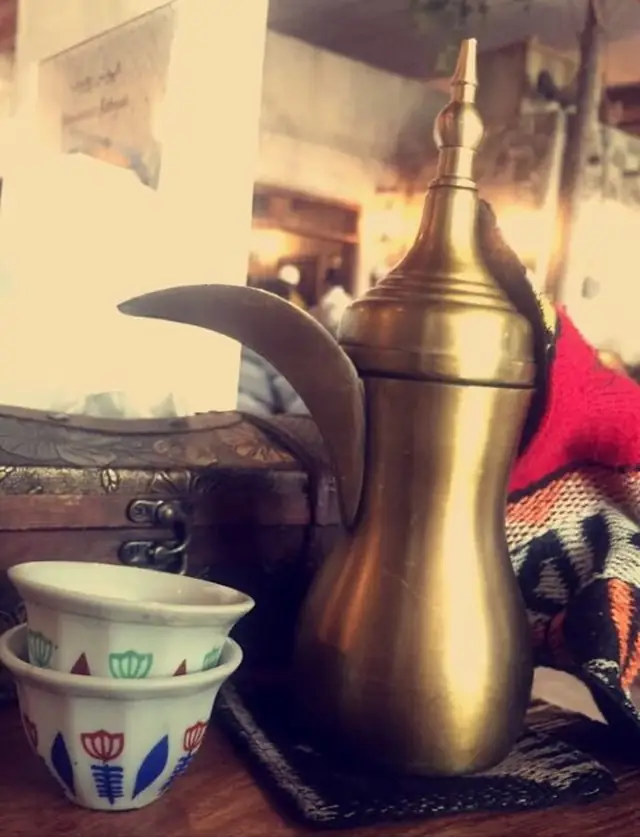
In the Emirati majlis, hospitality begins with Arabic coffee. When the host pours you coffee, it means you are welcome. Because of its place in society, UNESCO inscribed it on its list of intangible cultural heritage as «Arabic coffee, a symbol of generosity».[1][2][3]
Its taste: no sugar, no milk
Arabic coffee is served without milk or sugar and flavoured with cardamom, sometimes with saffron or rose water. These flavourings are called «al qanad». It is usually served with dates.[2][4]
The «maameel» tools
The tools for making coffee share one name: the maameel. They include:[4]
- Tawa: an iron pan for roasting the coffee beans.
- Mihmas: the tool used to stir the beans while they roast.
- Rashad and minhaz: the mortar and its pestle, for pounding the beans.
- Dallat al khamra: the pot in which the water is boiled first, holding 2 to 4 litres.
- Dallat al mazla: the pot from which the coffee is served to guests. Palm fibre is placed in the spout of the dallah to filter the coffee.
The finjans are small cups without handles into which the coffee is poured.[5]
The etiquette of the coffee server
The person who pours the coffee, the «muqahwi», follows clear rules and manners:[4]
- He holds the dallah in his left hand and serves the cup with his right.
- He starts with the oldest or most important guest, then carries on from right to left.
- He never fills the cup; he pours only a little.
- He invites the guest politely — «tfaddal itqahwa» — and after serving the cup he steps back a few paces before carrying on.
- He stays standing until he has served every guest, while the host welcomes his guests and talks with them.
And what does the guest do?
A guest usually drinks at least one cup and no more than three. When he has had enough, he shakes the cup, and the server understands that he wants no more.[4][3]
There are lovely phrases for that moment: if the guest says «ghanimt» as he hands back his cup, the server replies «salimt»; if he says «kafi kafait al sharr», the reply is «kafait w salimt». And «gahwatkum mashrouba» means the guest thanks his host and politely declines another cup.[4]
More than a drink
By Emirati custom, a single cup of coffee can lead to a reconciliation, an engagement or the settling of a dispute. Among the proverbs: «finyal al dhuha akhyar min dhalul» — a morning cup of coffee is worth more than owning a fine she-camel — and «illi ma indah dallah ma had yindallah» — no guest will seek out a house whose owner does not serve coffee. After the coffee and the conversation, hospitality ends with incense and oud.[4]
To keep this heritage alive, the Department of Culture and Tourism – Abu Dhabi launched the «Bait Al Gahwa» (coffee house) initiative, which revives the way coffee is made and served and passes it on to the next generations.[4]
Test yourself
Three questions from the article. Answer, then tap «Show the answer».
With which hand is the coffee cup served to a guest?
- AThe left
- BThe right
- CBoth hands
- DIt does not matter
Show the answer
Correct answer: B) The right
How does a guest show the server he has had enough coffee?
- AHe puts the cup on the floor
- BHe stands up
- CHe shakes the cup
- DHe covers the cup with his hand
Show the answer
Correct answer: C) He shakes the cup
What is the «tawa» in making coffee?
- AAn iron pan for roasting coffee beans
- BA small dallah
- CA bag for keeping cardamom
- DThe tray for the cups
Show the answer
Correct answer: A) An iron pan for roasting coffee beans
Want more?
Play the full “Al Sanaa (etiquette)” category in Uloomak, with questions from easy to hard.
Play now